

Springfield Properties (LON:SPR) — Stock in Focus
The North Scotland Housing Play Trading Below Book


Ticker: SPR
Share price: c.98p
Market cap: c.£117m
Tangible book value: c.140p per share
P/TNAV: c.0.7x
Balance sheet: c.£1m net bank cash at FY26 year-end (31st May 2026)
Springfield Properties has repaired its balance sheet and now trades at a significant discount to tangible book value, with a substantial landbank in a region that could benefit from decades of infrastructure investment.
Why I’m Interested
Eighteen months ago, Springfield looked like a balance-sheet recovery story.
Net bank debt had peaked at £93.4m and investors were focused on leverage, liquidity and whether the company could navigate a weak housing market without damaging shareholder value.
Following yesterday’s RNS, the picture now looks very different.
Springfield has eliminated bank debt entirely and finished FY26 with approximately £1m of net bank cash.
Yet the shares still trade at around 0.7x tangible book value.
After top-slicing EnSilica and Inspiration Healthcare, and with the Cordel takeover looking increasingly likely to complete, I’ve been looking for somewhere to redeploy the proceeds. I’ve topped up my Intercede holding, but nothing else on my watchlist is screaming obvious buy.
What attracts me to Springfield is the combination of asset backing and optionality. It gives me exposure to a potential housing recovery, with tangible land assets providing valuation support if the cycle takes longer to turn. The upside is the North Scotland infrastructure build-out.
The investment case comes down to three things:
The balance sheet has been transformed.
The landbank has been externally validated.
The North Scotland opportunity is becoming increasingly tangible.
The Balance Sheet Has Been Transformed
When markets weaken, highly leveraged businesses can be forced to sell assets, raise equity or cut investment at precisely the wrong point in the cycle.
A stronger balance sheet means lower interest costs, greater flexibility, improved resilience during weaker markets and a reduced risk of being forced into unattractive asset sales.
With bank debt eliminated, the focus can shift back towards asset value, landbank quality and future growth opportunities.
The Landbank Has Been Externally Validated
The second reason I am interested is the asset backing.
In February 2025, Springfield agreed to sell 2,480 plots to Barratt Redrow for £64.2m at 1.3x book value.
That suggests Springfield’s asset base may be carried conservatively.
Importantly, tangible book value should not necessarily be viewed as a ceiling on intrinsic value.
The Barratt Redrow transaction suggests at least part of Springfield’s landbank may be worth more than its balance-sheet value. It would be wrong to extrapolate that valuation across the entire portfolio, particularly as this was prime Central Scotland land, but it does indicate that reported net asset value may be conservative rather than aggressive.
At 98p, the shares trade around 30% below tangible book value. If Springfield merely traded at asset backing, the shares would be worth approximately 140p before assigning any value to future growth from North Scotland or the SSEN opportunity.
Even after that sale, Springfield retained a substantial landbank: around nine years of activity at current sales rates, with a gross development value of £1.9bn.
The Land Is Increasingly In The Right Place
The balance sheet repair and discount to book value make Springfield attractive today. The North Scotland strategic focus is what makes it look interesting for the next 6-12 months. When buying a share I always want to be looking for a catalyst that could rerate it over this kind of time frame.
A Landbank Built Over Decades
One aspect that is easy to overlook is how long it has taken Springfield to assemble its landbank.
The business was founded in 1956 by Sandy Adam’s father, with Sandy Adam later joining and helping build Springfield into one of Scotland’s largest independent housebuilders.
Over almost seventy years, the company has accumulated land, planning expertise and local relationships across Scotland.
At H1 FY26, Springfield had 7,305 owned and contracted plots and a further 6,293 strategic plots, giving it control over more than 13,500 plots in total.
Replicating that position would require significant capital, planning expertise and, most importantly, time.
Land can be bought. A development pipeline with planning progress, local authority relationships and strategic land options accumulated over decades is much harder to emulate.
Springfield already has a substantial footprint in the North of Scotland, just as the region is becoming increasingly important to the UK’s future energy system.
Why North Scotland Matters
Innes Smith explained the opportunity well in the latest investor presentation.
The North of Scotland has “a lot of wind”.
In this case, the joke is also the investment point. The region is exposed to strong Atlantic and North Sea weather systems, giving it some of the best wind resources in the UK. That is why so much renewable generation is being developed in the North, even though much of the electricity demand sits further south.
Moving that power from where it is generated to where it is needed requires major grid investment. That means substations, cabling, construction workers and long-term infrastructure activity.
Those workers need housing.
Electricity demand is being pulled higher by electrification, decarbonisation and the growth of power-hungry digital infrastructure, including AI and data centres.
The IEA expects global data-centre electricity consumption to roughly double by 2030, underlining how important reliable power supply and grid capacity are becoming.
North Scotland now has several large, identifiable drivers of future housing demand:
SSEN Transmission is progressing a major electricity transmission upgrade programme across the North of Scotland, linked to tens of billions of pounds of planned and approved investment.
The workforce associated with that investment is expected to peak at around 5,000 workers.
The Inverness and Cromarty Firth Green Freeport is expected to attract over £6.5bn of investment over the next 25 years and support more than 11,000 long-term jobs.
Highland Council is targeting the delivery of 24,000 new homes over the next decade.
Springfield already owns land in the region where much of this activity is expected to take place. If housing demand accelerates, the company is starting from a position of strength.
The SSEN Opportunity
Springfield can build permanent homes, lease them during the infrastructure phase and then potentially sell those homes through traditional private, affordable or institutional housing channels once the lease period ends.
Management has already confirmed that initial SSEN funding has been received, construction is progressing and first-phase contracts are at an advanced stage of negotiation.
The economics have not yet been fully disclosed, although management has indicated that the expected return on capital is attractive.
Management Alignment
Management alignment is another positive.
Executive Chairman Sandy Adam has spent most of his career building Springfield and remains a major shareholder. Springfield’s own significant shareholder disclosure shows Sandy Adam holding 27.7m shares, representing 23.3% of the issued share capital, including his direct and indirect holdings and those of Anne Adam.
That is meaningful skin in the game.
The wider Adam family ownership also appears material. Recent shareholder data shows Alexander William Adam holding around 25.0m shares, Scott Alexander Adam holding around 5.9m shares and Gordon Duncan Adam holding around 5.3m shares.
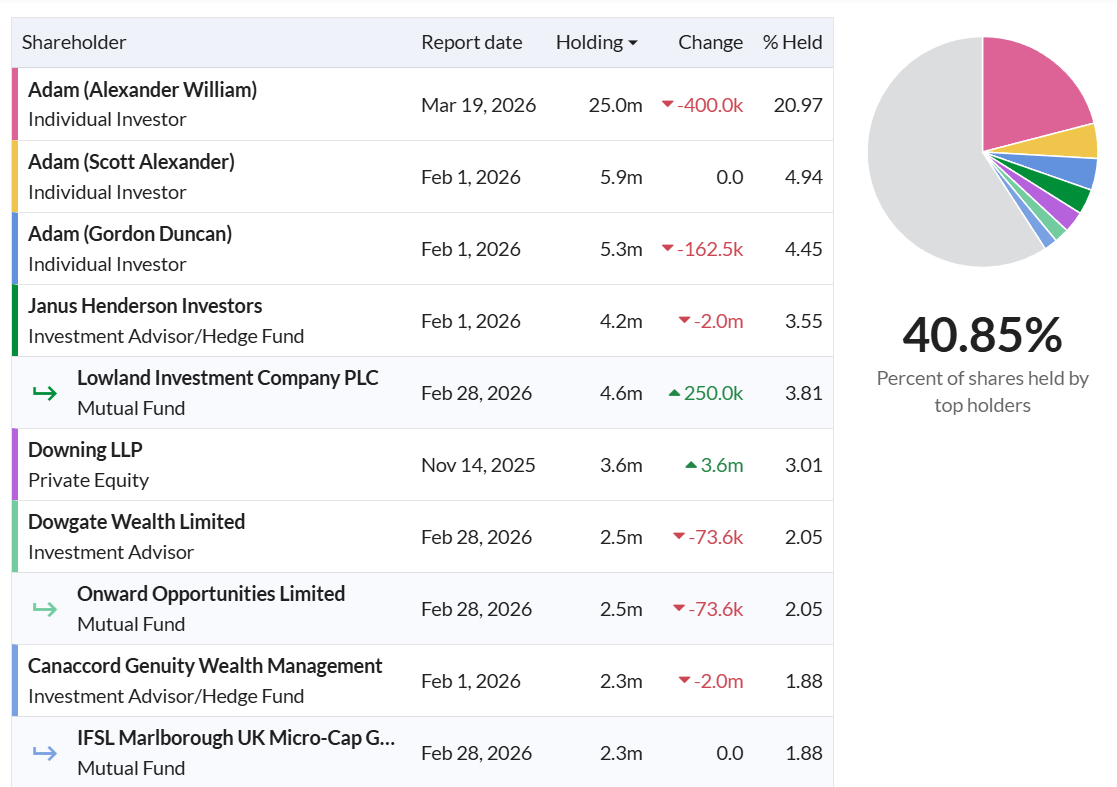
Major shareholders as at 05.06.2026 source: stockopedia
Taken together, the family ownership structure reinforces the point that this is not a detached management team managing other people’s capital. The key shareholders have a long-term economic interest in how the landbank is protected, developed and monetised.
CEO Innes Smith has also been with the business for over two decades. In the latest presentation, he came across as measured, candid and commercially grounded. The message was clear: repair the balance sheet, protect the landbank and the strategic focus on the North Scotland opportunity where Springfield already has regional scale.
Risks
Springfield remains a cyclical housebuilder.
Mortgage availability, affordability, buyer confidence and interest rates still matter. If the UK housing market weakens again, Springfield will not be immune.
The North Scotland opportunity may also take longer to develop than investors expect. Infrastructure projects can be delayed, workforce requirements can change, and housing demand projections can prove optimistic.
The SSEN opportunity is attractive, but the economics are still not fully disclosed. Until Springfield provides more detail on margins, lease terms and capital requirements, I am treating it as upside optionality rather than banking it into the valuation.
Competition also exists.
Springfield does not have a monopoly on the North of Scotland. Larger housebuilders can still compete aggressively if they choose to.
However, Springfield does appear to have a more defensible position in this locality than many larger national operators. In a market where land availability, planning progress and local delivery capability matter, that existing footprint should not be dismissed.
There is also no guarantee the market rerates the shares simply because they trade below book value. Cheap shares can remain cheap for a long time.
The difference today is that the balance-sheet risk has been materially reduced. That does not remove the cyclicality, but it does improve the risk-reward profile versus eighteen months ago.
Valuation
At around 98p, Springfield trades at roughly 0.7x tangible book value and offers a modest dividend yield. The shares also screen cheaply on historic earnings, and a number of Benjamin Graham value metrics - but for me the asset discount matters more than the P/E, given the cyclicality of housebuilding and the timing risk around recovery.
Net assets stood at approximately £172m at the half-year stage, compared with a current market capitalisation of around £117m.
After adjusting for intangible assets, tangible book value is approximately 140p per share. That compares with a current share price of around 98p, meaning the shares trade at roughly a 30% discount to tangible net asset value.
Based on c.140p tangible book value per share:
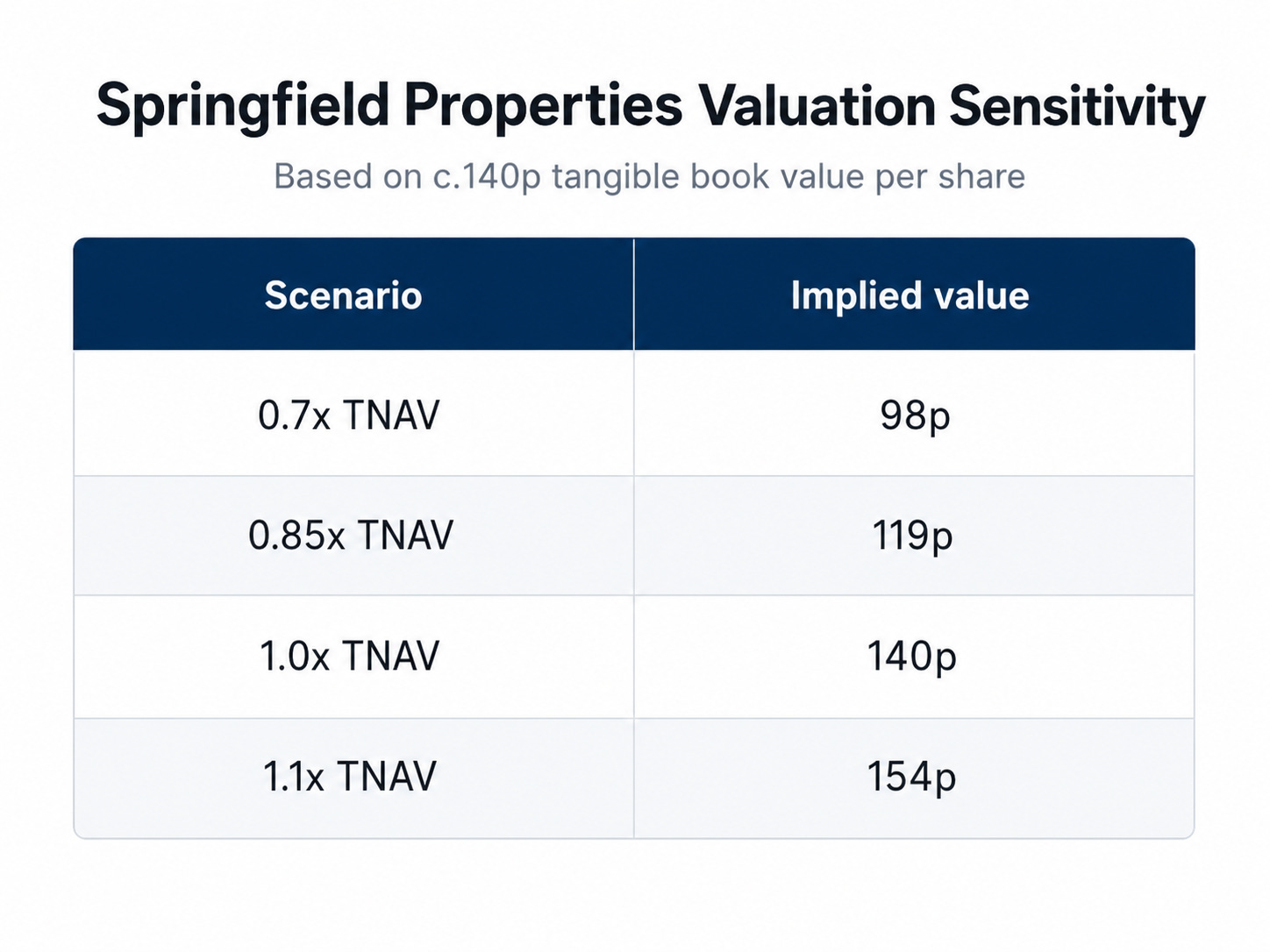
That does not assume a heroic valuation. It simply shows what the shares could be worth if the market starts to recognise more of the asset value already on the balance sheet.
The key test from here is whether the repaired balance sheet can translate into sustainable earnings, cash generation and acceptable returns on capital.
A bear case is that housing demand stays weak, development margins normalise lower, and the market continues to apply a discount to asset backing because the landbank is illiquid and the SSEN opportunity takes longer to monetise than expected if at all further. In that outcome, the shares could remain cheap for a prolonged period even if tangible book holds up better than the market assumes.
Verdict
Springfield is not risk-free. It remains a cyclical housebuilder exposed to mortgage rates, buyer confidence and housing-market sentiment.
But the investment case looks materially stronger than it did eighteen months ago.
The bank debt has gone. The landbank has been partially validated above book value. The shares still trade at a meaningful discount to tangible net assets. And the North Scotland opportunity gives the company an additional growth angle that is perhaps not available to most UK housebuilders.
For me, that combination is attractive. The valuation provides the margin of safety. The North Scotland opportunity provides the upside.
Opened a starter position purchasing 5,000 shares on 5th June 2026 at 97.74p.
OnlyCharts launches on 1 July 2026.
You can follow @SmallCapsBigBags on X for daily UK small-cap updates.
The public portfolio tracker is at smallcapsbigbags.com.
Read next>
📊May Portfolio Update & 12-Month Review: Four Multi-Baggers, One Takeover Bid and a £50k Portfolio

Small Caps. Big Bags. is an open investment journal where I document my high-conviction small-cap portfolio. Each month I share what I buy, what I sell, what works — and what doesn’t. Importantly, this is not financial advice or a stock-picking service. It’s simply a transparent record of my thinking, process, and lessons learned investing in UK small a…
Nothing in this article is financial advice or a buy or sell recommendation. I own shares ins Springfield properties. Always do your own research and make sure any investment approach is suitable for your own circumstances. All content on Small Caps. Big Bags. is for informational and educational purposes only and reflects my personal views. Past performance is no guarantee of future returns. Nothing constitutes financial, investment, legal, or tax advice. I am a private investor, not a regulated adviser. Investing in small-cap and AIM stocks involves significant risk, including volatility, illiquidity, and the potential for total loss of capital.You should conduct your own research and seek professional advice where appropriate.I may hold positions in the stocks mentioned, which may change without notice. No liability is accepted for any losses arising from reliance on this content.
The last time they traded above net asset value was January 2022. Shows just how long the cycles can take to come round
As you state the nth of Scotland is still open for debate. Am concerned that there could be some slips twixt cup and lip, especially on the leasing of the properties. Would the highland and islands underwrite and be a guarantor to take them at end lease for social housing